Cloudy Appearance
Suspended fine particles can scatter light and make water appear cloudy.
ONE POD. COMPLETE WATER SOLUTION.
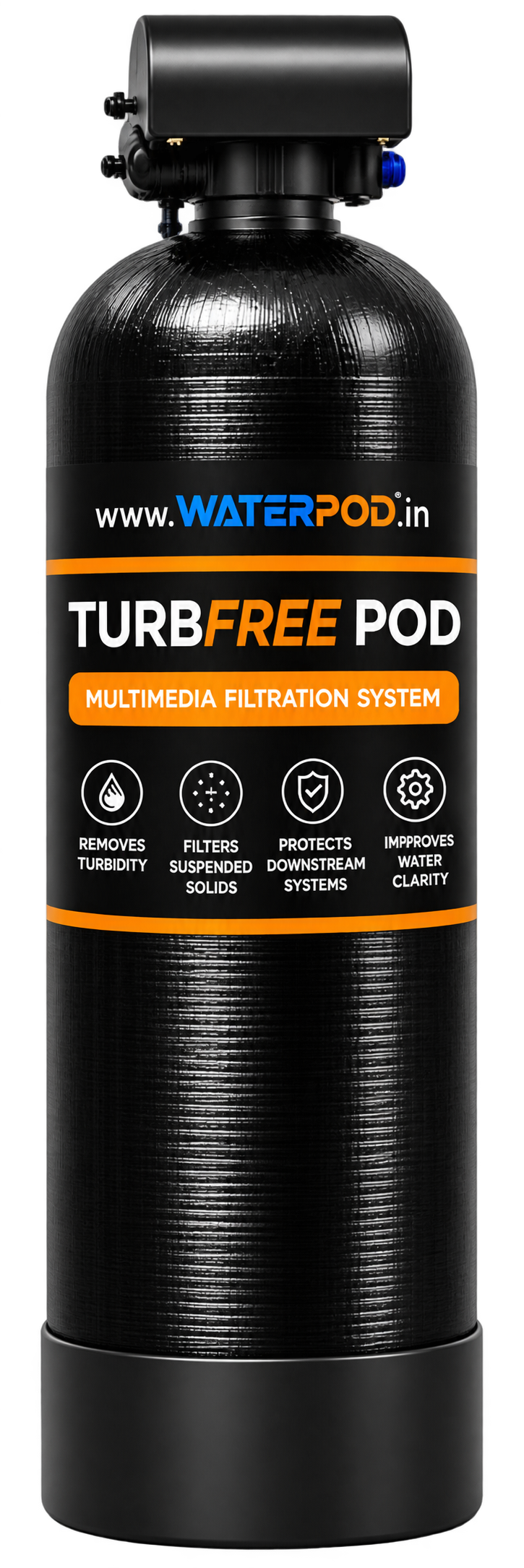
Meet WATERPOD Turbfree — a filtration stage intended for water with elevated turbidity caused by fine suspended particles. The right filtration arrangement starts with understanding your source water.
Turbidity describes the cloudiness of water caused by suspended particles that scatter light. Fine particles may remain suspended even when larger visible solids have been removed.
WATERPOD Turbfree is intended as a filtration stage for elevated turbidity, with the media and process selected according to source-water analysis and design requirements.
Suspended fine particles can scatter light and make water appear cloudy.
Smaller particles may require a filtration arrangement selected for their characteristics.
Source-water conditions and solids loading can vary, making monitoring important.
A suitable media bed or filtration arrangement captures particles contributing to water turbidity.
Understand inlet turbidity, particle characteristics and solids loading before selecting the filtration process.
Water flows through the selected media bed or filtration arrangement.
The selected filtration arrangement captures particles that contribute to turbidity.
Backwashing and monitoring requirements depend on the chosen media, inlet turbidity and accumulated solids loading.
Turbfree can be evaluated for supplies where elevated turbidity is identified as a treatment concern.
Evaluated when water analysis identifies turbidity caused by suitable suspended particles.
Considered as part of pretreatment where source-water turbidity requires attention.
Can be assessed for building supplies where turbidity is a confirmed concern.
Evaluated according to process requirements, inlet quality and operating conditions.
Both are filtration categories, but the selection depends on the particles and turbidity identified in the source-water analysis.
Intended for filtration of suitable suspended particles such as visible sand, silt and other filterable solids.
Explore SandPodIntended for water with elevated turbidity caused by fine suspended particles, subject to media and process selection.
YOU ARE HEREThese categories are not interchangeable by name alone. Particle size, turbidity, solids loading and process requirements should guide the final selection.
Turbidity can have different causes and particle characteristics. A suitable system should be selected only after reviewing the source-water conditions and application requirements.
Turbidity can result from different particle characteristics and source-water conditions. Turbfree should not be presented as a treatment for dissolved chemicals or as a guarantee of microbiological safety. Final media selection, sizing, backwashing and monitoring must be based on water analysis and engineering requirements.
Share your water source, turbidity concerns and application requirements. Start with a water assessment to explore the right filtration approach.